How AI Is Changing Software Development and What It Means for Your Business
 Read Time: 9 minutes
We’re here to split hairs on the various forms AI can take in the development of software and offer insight into how you can use each to your advantage.
Recently, we surveyed our readers about what topics they were most interested in hearing about. The answer was overwhelmingly All Things AI. The speed at which this technology is developing and its ubiquitous availability has left many people feeling hopeful yet plagued by FOMO.
Most of our readers aren’t developers—they’re the business leaders deciding whether to hire, outsource, or rebuild teams of developers. If AI can write code, it’s natural to wonder if it can replace human labor, and if so, to what degree? Could off-shore teams that once struggled with quality now succeed with the help of AI? If you develop in-house, are you still paying for positions that have become redundant? What are the risks of using AI in your software development?
Keep in mind that AI is moving fast—here’s what’s true for now.
The Basics of AI-Assisted Development
Artificial intelligence has entered the scene and it comes wrapped in some very big promises. Speed, affordability, and accessibility are among the most interesting benefits that appear to be on the table.
AI is capable of delivering on these promises, but only when approached from a point of knowledge about its iterations, parameters, and risks. Right now, three main concepts are being explored in software development:
- AI-assisted coding
- Vibe coding
- Agentic development
The tools used for these approaches often overlap, and distinctions can seem fuzzy. Each of these topics will be explored in-depth in future articles, but for now we’ll stick with an overview.
AI-Integrated Coding Tools
AI-integrated tools work inside existing development environments. They assist developers with real-time suggestions, automatically write or refactor code, and integrate directly with test and deployment systems.
If traditional coding is like a chef in the kitchen—one who works with raw ingredients and builds a recipe step-by-step—AI-integrated tools would be like adding in a skilled sous chef. The chef no longer peels vegetables and stirs sauce for twenty minutes, but he is still in charge of the meal. He directs the sous chef’s activities and checks their work. He knows every ingredient that is used, how the meal comes together, and whether it meets his personal standards.

Likewise, skilled developers using AI-integrated tools will produce high-quality code, with the added bonus of having better control over the use of their time.
But putting AI tools into the hands of an unskilled developer won’t automatically get you higher-quality software. That would be like pairing a sous chef with a cook at McDonald’s. Despite the sous chef’s capabilities, they won’t have a meaningful impact on the final product.
Should Your Team Be Using AI-Integrated Tools?
The short answer: Yes! AI-integrated tools are becoming the standard for serious teams. This form of AI represents a practical entry point into the future. Productivity improves without abandoning structure. Teams can move faster and reduce costs, while leadership can maintain confidence in quality and security.
The caveat: AI saves time but doesn’t replace judgment. Oversight is still necessary, and the quality of that oversight is what will ultimately determine the quality of your product.
Vibe Coding
If traditional coding is like a chef in a kitchen, and AI-integrated tools are like a kitchen with a sous chef, then vibe coding is the equivalent of taking the night off and ordering DoorDash. You can order a complete meal, but you’ll have no idea what went into it or how it was made.
With vibe coding, instead of professionals writing code, a large language model (LLM) generates entire applications from natural-language prompts. A single person can describe what they want in plain English: “a new dashboard”, “a customer portal”, “a mobile app”—and receive working code in minutes.
The appeal is obvious: cost reduction, speed, and an absolute leveling of the playing field in regard to accessibility. But the risks are significant. Code produced in this way is often inconsistent, insecure, and difficult (or impossible) to maintain. The person issuing prompts has little control over structure or scalability. What looks like a bargain today is technical debt tomorrow.

Does Vibe Coding Have a Place in Professional Workflows?
Does this mean that vibe coding should be dismissed out-of-hand? Not necessarily. Vibe coding has collapsed the distance between idea and prototype. It opens doors for experimentation and idea exploration. An experienced designer might vibe code to try out different interaction patterns and see how ideas work with realistic data. But they then hand that off to an engineer, who treats it as a reference point for building a stable, secure product.
In professional environments, vibe coding is a serviceable tool for discovery, but not for development. It can prove a concept quickly, but cannot sustain it.
Agentic Development
Agentic development is a new approach to software creation where AI agents act as semi-autonomous collaborators, capable of planning, writing, testing, and refining code with limited human input. Instead of responding to one prompt at a time, these agents operate with goals. A developer might input, “Add error logging to the payment system and update the tests,” and the agent will read the repository, identify the right files, make the changes, and even open a pull request for review.
This is different from vibe coding in that these agents work iteratively, refining their output under human supervision. Vibe coding creates code once, while agentic development continuously builds, tests, and improves it within an organized workflow.
In agentic development, the AI is given the power to act. It can reason through a problem, use APIs, run tests, and coordinate with other agents to complete multi-step tasks. Developers shift from writing every line to supervising, reviewing, and setting boundaries.
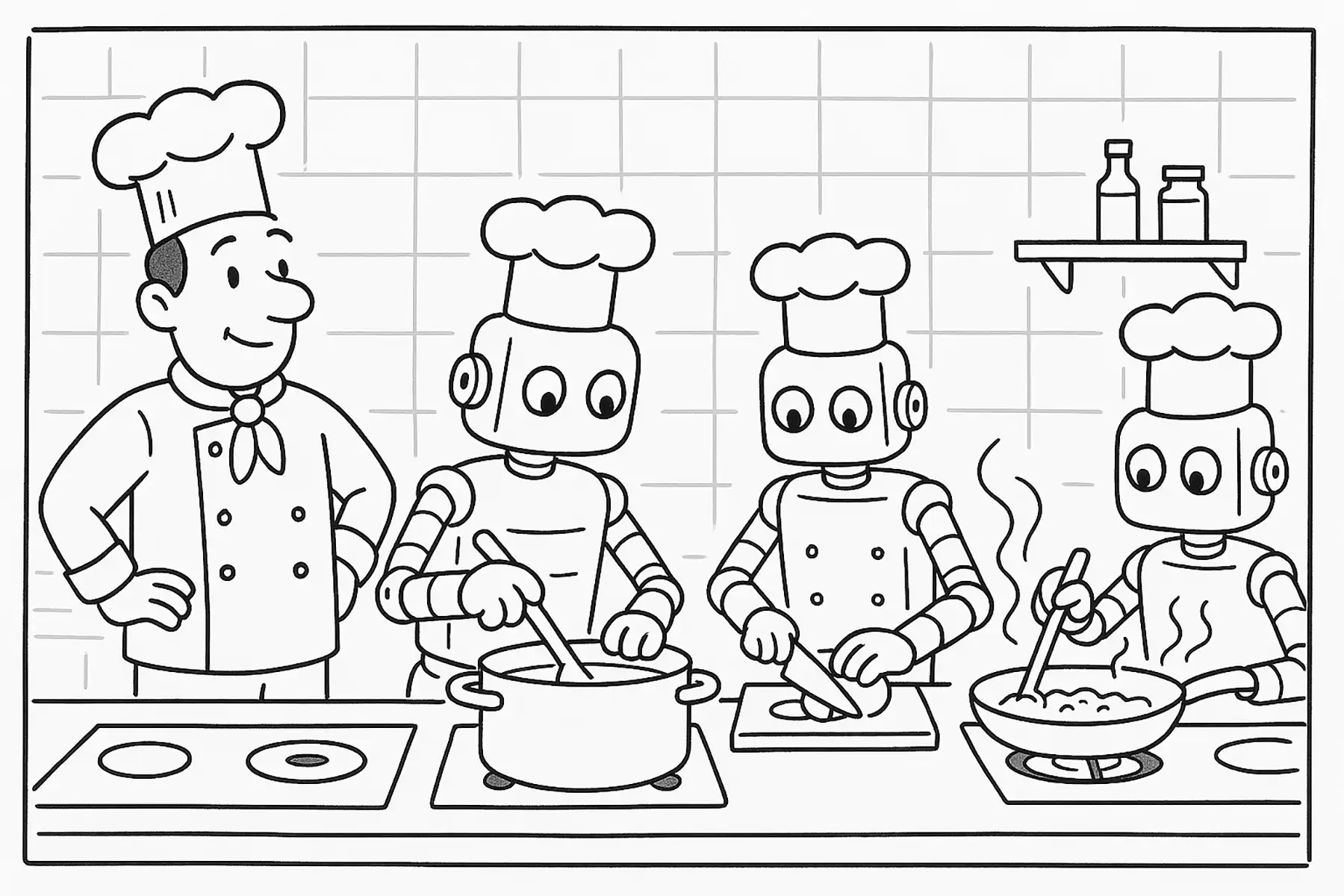
In an effort to squeeze every last drop from our cooking analogy, it’s like a large professional kitchen with a full staff. The chef is still in charge and has the same end goal, but his skill set must shift from cooking to menu planning, staff management, and quality control. He’s responsible for the meal while no longer having his hands on the food.
Should Your Team Be Using Agentic Development?
We’ll answer that question with another question: How good is your team?
Agentic development is powerful, but these are early days, and what makes it so powerful is also what makes it high-risk: access. These systems often need broad access—to source code, repositories, APIs, and credentials—to act effectively. That access can create exposure. Over-permissioned agents can become targets for malicious actors. They can leak sensitive data through a poorly designed prompt or log. An agent that generates or executes code could introduce vulnerabilities or malicious dependencies.
Mitigations exist—sandboxing, limited API scopes, review checkpoints—but agentic development remains high-risk for regulated or security-sensitive projects. Most responsible teams are running pilots for automated maintenance, testing, or code translation in isolated environments, not production.
So, should your team use agentic development? It depends on their maturity and security rigor. If your team is highly skilled in DevOps and security, and can manage access, testing, and oversight, you’re better positioned to run these pilots safely. Less experienced teams may be better off waiting until the risks and mitigations mature.
The Bottom Line
The real value in understanding these new forms of AI-assisted development isn’t in choosing a winner, it’s in seeing how they fit together. Each represents a different expression of what “AI in software” can mean. Sometimes it’s a quiet collaborator inside your editor, other times it’s a conversational partner that can spin up ideas on command, and increasingly, it’s a system of agents capable of acting with intent.
These distinctions matter because they set expectations. Knowing whether an AI is a helper, a generator, or an autonomous actor changes how you manage risk, assign oversight, and measure value. It moves the conversation from hype to strategy.
AI isn’t transforming development in one sweeping motion, it’s unfolding in layers. The businesses that will benefit most are those that understand where each layer belongs, and can tell the difference between a shortcut and a paradigm shift.
TL;DR
- AI is reshaping software development through three main approaches: AI-assisted coding, vibe coding, and agentic development—each with distinct benefits and risks.
- AI-assisted tools boost developer productivity but still rely on human judgment and oversight to ensure quality and security.
- Vibe coding is best suited for discovery—it helps teams quickly explore ideas and prototypes, but the output isn’t reliable enough for real-world development.
- Agentic development introduces semi-autonomous AI collaborators that can plan, write, and test code, offering major efficiency gains but raising new security and governance challenges.
- You are still needed, fellow humans.



We are custom software experts that solve.
From growth-stage startups to large corporations, our talented team of experts create lasting results for even the toughest business problems by identifying root issues and strategizing practical solutions. We don’t just build—we build the optimal solution.
From growth-stage startups to large corporations, our talented team of experts create lasting results for even the toughest business problems by identifying root issues and strategizing practical solutions. We don’t just build—we build the optimal solution.