Bright Lights, Big Hype: Agentic AI’s Role in Software Development
 Read Time: 6 minutes
Depending on who you ask, Agentic AI is either a miracle, a disaster, or a wild card. We say it’s all of the above.
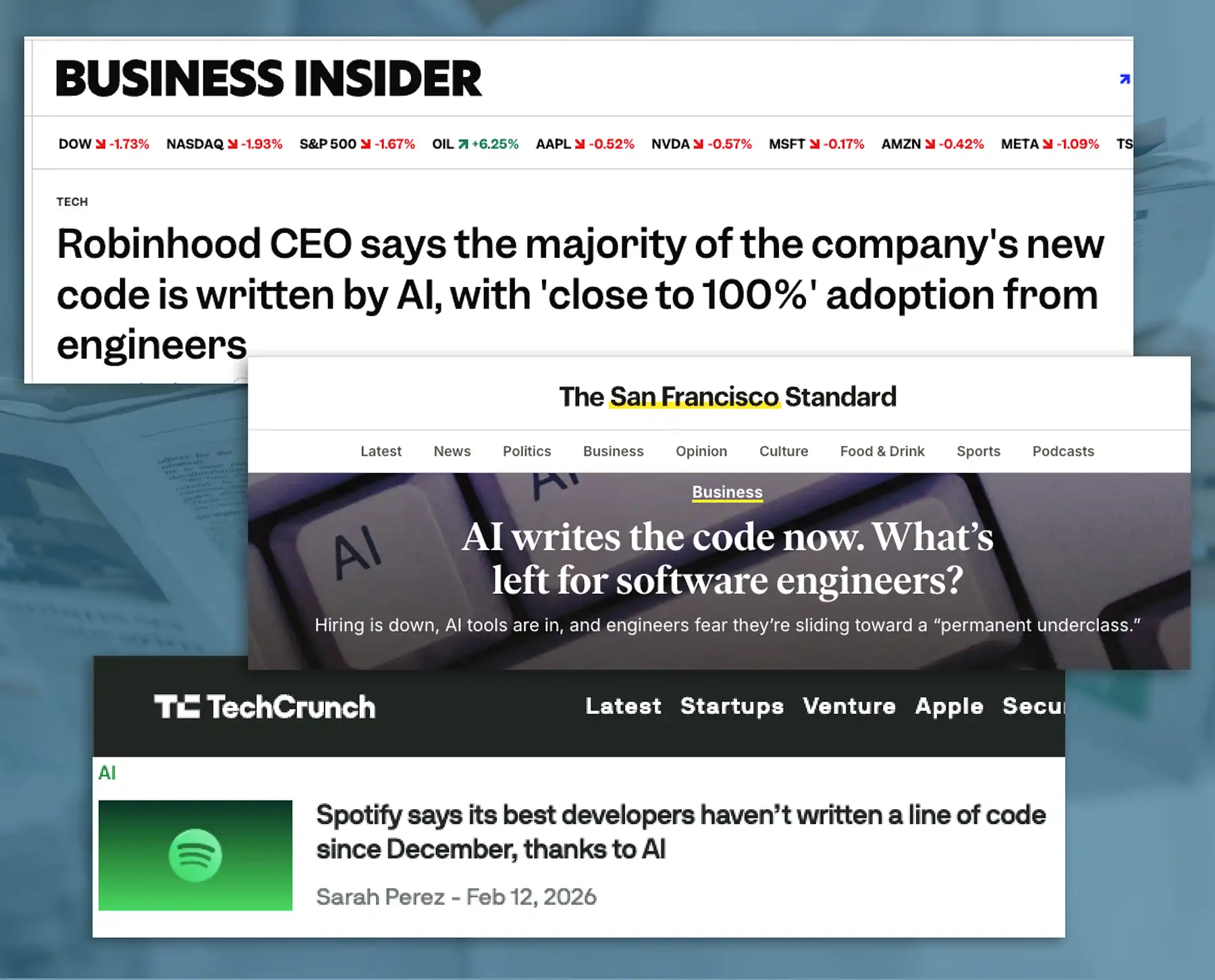
Confession time: Ever since promising an in-depth article about Agentic AI, I’ve made several drafts on the subject, and by the time I finish one, we’ve already learned so much more that it feels out of date. This technology is developing at lightning speed, and my teams use it every day. But I’ve noticed a disconnect between our hands-on experience and the way many big headlines claim it’s being used.
So without getting too deep in the technical weeds, we’re going to talk about what Agentic AI is and the role it plays in professional software development.
How Does Agentic AI Work?
First, let’s get the definitions out of the way. Simply put, agentic AI refers to an LLM connected to programming tools that can take actions and operate in a loop. It acts, evaluates, and iterates.
Older AI-assisted development tools were helpful bystanders. You could ask a question and get an answer. You could autocomplete or get a snippet of source code. The LLM could assist you but couldn’t do anything on its own.
Today’s agentic AI coding agents (OpenClaw, Hermes, Windsurf, Cursor, Codex, Claude Code, etc.) run in an agentic loop. This means that with each question you ask, the agent can decide to execute a tool or command, or write a response to you.
When it chooses to take an action such as performing a web search, editing code, or running a Git command, it will evaluate the result and then—as part of the agentic loop—decide whether to run another tool or to give you a response. It keeps going in this loop until the task is accomplished. Additionally, it can send off sub-agents to complete a subtask. It can do this many, many times, very, very quickly. It is an empowered participant that follows the user’s guidance.
Because agentic AI’s usefulness depends so heavily on the LLM it uses and the quality of context it is given (such as user guidance), results vary significantly. It’s a conceptually new way of coding, and as such it needs to be learned and mastered to get the best results, even for seasoned engineers.
Software Development Is More Than Coding
But coding itself is only one layer of software development. Agentic AI has radically changed how programmers program, but a lot of work happens before a project even gets to that stage.
To illustrate, if you’re building a custom home, you don’t start with lumber and nails. You start with an idea, then work closely with an architect to design a house that suits your needs and is structurally sound. Only after that do contractors step in to execute. Software development is very similar. It starts with an idea and moves through design and iteration before anything is built in code.
All of that space between conception and coding is filled with communication. As much as we’ve come to rely on AI, it does not replace real communication between humans. The strongest engineering results come from communication that questions and pushes back on assumptions.
This is something that LLMs are not designed to do. An LLM’s default behavior is to “get along with” and “please” the user in a highly superficial way. Chatbots can generate code and even suggest architectures, but they do not inherently challenge assumptions. They will happily tell you what is technically possible, but not whether it has strategic value unless repeatedly prompted to do so..
How We’re Using Agentic AI Professionally
When it works well, agentic AI compresses entire layers of execution. Work that used to require careful coordination between engineers can be scaffolded quickly by a single person directing an agent or multiple agents. It is genuinely revolutionizing software development, not just in terms of speed, but in how the work is shaped. Engineers spend less time on mechanical assembly and more time steering, reviewing, and refining.
Concurrently, more time is being spent on product design and strategy. My teams are using agentic AI for faster prototyping cycles, broader exploration of design options, and automated documentation. They use it for in-depth analyses that were previously cost-prohibitive, which allows them to base design decisions on principles from cognitive science. Every week we are surfacing new ways to implement the newest AI tools. We recently documented how our team used AI to decode a cryptic legacy database that had become increasingly difficult to maintain and understand.
Headlines vs. Reality: The Constraints of Agentic AI
Obviously, we’re fans of agentic AI and use it daily. But I’m seeing a repeated narrative that lacks context. There’s a persistent myth that software teams are being entirely replaced with AI. That companies are shipping production systems with little to no human involvement, and that the act of writing code is obsolete. This makes for bold headlines, but it skips over some very real constraints.
Teams using agentic AI in serious environments run into three realities quickly.
- Costs can add up quickly. At scale, token usage becomes a line item that needs to be managed like any other infrastructure cost. Iterative agent workflows (those loops we talked about earlier) can consume thousands of tokens on a single task. Costs quickly become unpredictable and frequently exceed expectations, and you still have to pay humans to monitor and orchestrate the agents.
- Evaluating for accuracy takes time. Agents can create thousands of lines of code in seconds, but it can take much longer to review it carefully. Quality control can quickly become a bottleneck, or even an expanded layer of work: verifying agentic results and/or correcting mistakes (more on that later).
- Security becomes more complicated. Beyond access control, teams need to think about prompt injection inside repositories, unsafe command execution, dependency tampering, and the risk of automated systems exposing sensitive data through logs or prompts. For heavily regulated industries, this is a huge deal. The liability for HIPAA violations, SEC recordkeeping failures, or fiduciary breaches is the same whether the disclosure was made by a human or an automated process.
None of these are arguments against using agentic AI. They’re arguments against pretending it’s cheap, effortless, or infinitely scalable without tradeoffs.
What this shows is that extreme headlines and stories often represent edge cases with deep pockets working on greenfield projects. In contrast, Google reports an average 10% increase in “engineering velocity” due to AI. That 10% is meaningful—but it’s a far cry from the 40x claims I’ve seen in some articles.
Agents Are Impressive, Not Infallible
Coding is only one piece of building software. Understanding the strategy and architecture around it is still a human job. A skilled engineer using these agentic AI tools can move faster and explore more safely because they understand what good code looks like. They can spot when the agent is drifting, when abstractions are leaking, or when a change will create long-term problems.
Agents also have varying degrees of “skill” when it comes to different programming languages and frameworks, depending on how much training the AI had on that code. Good engineers will notice these differences and adjust accordingly.
At the end of the day, however, agentic systems are inherently non-deterministic. The same task can produce different outputs across runs, and even confident-looking results can be wrong. An agent can become hung up on an early assumption. When problems emerge, the agent often tries to fix them while assuming its initial logic was correct, even if it wasn't. It’s like repeatedly patching cracks in a building with a broken foundation. If you assume the foundation is fine, you’ll spend the rest of your life working on those walls. Experienced engineers can identify when this is happening, kill the session, and start over.
This inconsistency means that good teams invest significant effort in guardrails, retries, and validation layers—not to extend capability, but to make behavior stable enough to trust.
This is where risk can begin to compound. These systems are a powerful tool. They can generate large amounts of code quickly, make sweeping changes across a codebase, and operate with a level of autonomy that used to require a full team. In the hands of someone who knows what to look for, that’s leverage. In the hands of someone who doesn’t, that’s playing with fire.
A Powerful Tool That Is Easy to Use and Misuse
These agentic AI tools are so easy to interact with and seem so straightforward, they breed a false sense of security for inexperienced users. That is why we’ve had customers bring us in to remediate serious damage caused by AI tools that were used without sufficient expertise.
Using these tools can be compared to operating a bulldozer. Just about anyone can rent one. But could someone without experience use it to successfully remodel their front yard? Probably not. Could they make a giant mess? Definitely. Powerful tools can do a lot of good or a lot of damage, depending on who is operating them.
So despite what the headlines are often shouting, agentic AI is not a replacement for software teams, but a force multiplier. It expands what a capable engineer can do in a given amount of time, but it doesn’t remove the need for judgment and experience. If anything, these qualities are now the most important anchor points we can have in an increasingly automated process.





Jamie Smyth
Jamie Smyth is the CEO of The Smyth Group, a software development agency that he founded over 20 years ago. He has led development teams and solved business problems with software for clients such as Volkswagen, Columbia Sportswear, CAA, MedStar Health, and more.
Jamie is passionate about what it means to build good software. He covers topics dealing with security, AI, strategy, psychological safety, and more.