What Smart Leaders Ask Before a Security Incident Happens
 Read Time: 6 minutes
You don't need to be technical to protect your software. Uncover security risks while they are small and cheap to fix by asking your team six strategic questions.
Most business founders only encounter the security of their own software systems in two situations: after something has gone wrong, or when an enterprise customer sends over a procurement questionnaire full of technical security questions. The first is an expensive crisis; the second is an expensive delay.
Both of these situations can be avoided by leaders (even nontechnical ones) who adopt the habit of asking hard questions about their systems before something external forces them to.
While the underlying security concepts can be technical, business leaders don't need to solve security problems personally. They do, however, need to lead conversations that uncover risks before they become expensive surprises.
Getting Ahead of the Cost Curve
Adopting a structured threat framework offers the ability to shift risk mitigation into product planning before the cost curve spikes. Changes made at the design stage of a project cost a fraction of what the same changes cost after a product is built and deployed.
More importantly, understanding where your system is fragile changes how you lead. Instead of asking your engineering team "Is this secure?”—a vague question that will probably get a vague response—you can ask more pointed questions: Where could someone impersonate a user? What happens if this data is modified in transit? Who can access this feature, and why? These questions lead to concrete design decisions, and concrete decisions made early are money in the bank.
There's also a prioritization benefit. Not every vulnerability is worth fixing immediately, and not every feature deserves the same level of protection. But without a structured view of your threats, those tradeoffs happen haphazardly. When you've mapped your risks clearly, you can make deliberate investment decisions: where to build stronger controls, and where "good enough" is genuinely acceptable.
One of the most effective tools for building that habit is a framework called STRIDE. It provides a way for teams to think through how systems can be abused, compromised, or fail.
What Is STRIDE?
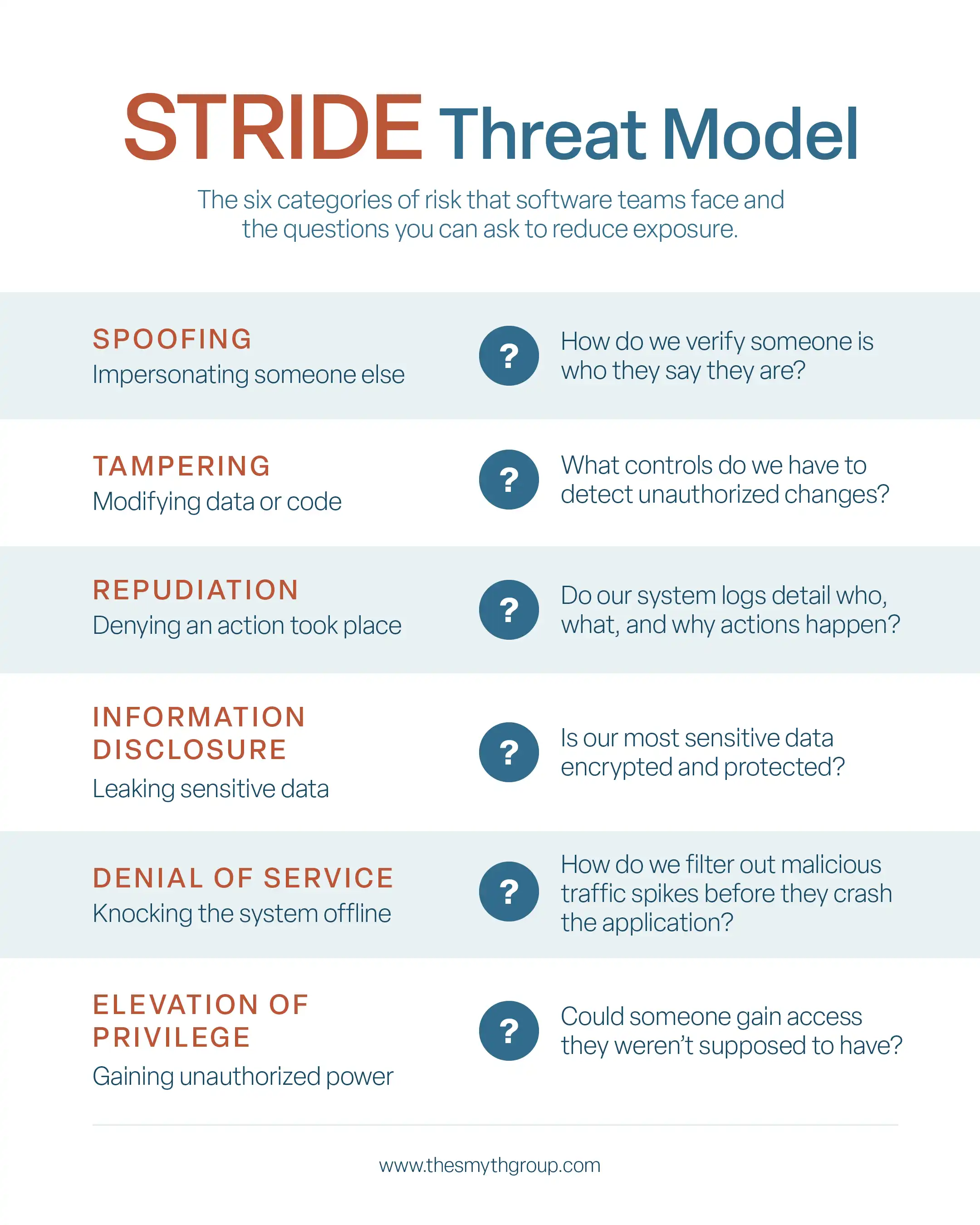
STRIDE is a threat modeling framework. It offers a structured way to identify the different categories of risk that any software system can face. It was developed by Microsoft engineers and has become one of the most widely used approaches to thinking about security in a strategic rather than reactive way.
The name is an acronym, and each letter represents a distinct category of threat:
- Spoofing
- Tampering
- Repudiation
- Information Disclosure
- Denial of Service
- Elevation of Privilege
These categories give you and your team a shared vocabulary for discussing risk in a way that's grounded in how systems typically fail.
Spoofing: Impersonating Someone Else
The Threat: A bad actor successfully pretends to be a legitimate user, an administrator, or a trusted external system.
The Business Fallout: Unauthorized platform access, identity theft, or fraudulent transactions on your platform.
The Question to Ask Your Team: "How do we verify someone is actually who they say they are when they log in from a new device or request a password reset?"
Tampering: Modifying Data or Code
The Threat: An attacker alters information inside your system without authorization—whether it’s data in a database, code on your servers, system configuration settings, or instructions sent to an AI model.
The Business Fallout: Financial data can be manipulated, system logs can be altered to hide a breach, or an automated AI agent can be tricked into ignoring its guardrails via prompt injection.
The Question to Ask Your Team: "How do we know if our data has been changed maliciously, and what controls do we have to detect unauthorized changes to our systems, data, or AI behavior?"
Repudiation: Denying an Action Took Place
The Threat: A user or an automated system performs an action but claims they didn't, and your system lacks the unalterable proof to challenge them.
The Business Fallout: If a user deletes data or an AI feature makes a critical automated decision, a lack of clear tracking leads to compliance failures, legal disputes, and an inability to audit what happened.
The Question to Ask Your Team: "Are our system logs tamper-proof and detailed enough to prove exactly why an action happened, and who or what triggered it?"
Information Disclosure: Leaking Sensitive Data
The Threat: Private, proprietary, or regulated data gets exposed to people who shouldn't see it.
The Business Fallout: Massive regulatory fines, legal liabilities, a catastrophic loss of customer trust if your proprietary data or customer records are leaked to the public, such as by employees pasting sensitive data into public AI tools.
The Question to Ask Your Team: "If our database were leaked tomorrow, is our most sensitive data encrypted and protected in a way that would make it extremely difficult for an attacker to use?"
Denial of Service: Knocking the System Offline
The Threat: Flooding your system with fake traffic or overwhelming your servers so legitimate customers can't access your product.
The Business Fallout: Immediate revenue loss, broken Service Level Agreements (SLAs), and angry customers fleeing to competitors.
The Question to Ask Your Team: "What happens if our traffic spikes by 1,000% in five minutes? Do we have a mechanism to filter out malicious traffic before it crashes the application?"
Elevation of Privilege: Gaining Unauthorized Power
The Threat: A user with low-level permissions—like a standard customer or a junior employee—finds a backdoor to gain master administrative controls.
The Business Fallout: Potential compromise of critical systems, allowing a malicious actor to access sensitive data, administrative functions, or infrastructure that should be off limits.
The Question to Ask Your Team: "How are we isolating admin tools from regular user accounts, and have we limited internal employee access to only what they strictly need to do their jobs?"
What This Means for Sales and Growth
If you're selling to mid-market or enterprise customers, security is already part of the buying process whether you planned for it or not. Procurement teams and security reviewers ask about your controls, your data handling, and your approach to risk. Frameworks like those published by OWASP (the Open Web Application Security Project) show up in these reviews.
When your team has already been thinking through threats systematically, these conversations change character. You're not scrambling to retrofit answers or make promises you hope to honor later. You're describing decisions you've already made, with documentation to back them up. That's a fundamentally different sales posture and it closes deals faster.
Security Is a Team Sport
One of the more underrated benefits of structured threat modeling is improved team culture.
When security thinking is concentrated in one specialist—or worse, in no one—it becomes a bottleneck. Features stall while waiting for reviews, and engineers avoid raising concerns because they don't want to slow down production. Security becomes a disruption forced onto projects rather than a habit built into them.
When a framework like STRIDE gets embedded into how your team works, that changes. Product managers start thinking about misuse cases when they write specs. Engineers consider trust boundaries when they design APIs. People in meetings start asking challenging questions naturally, because they've developed the vocabulary and the habit.
This kind of alignment develops through practice. And it comes at the bargain price of about 15 minutes at a time to work through the STRIDE questions.
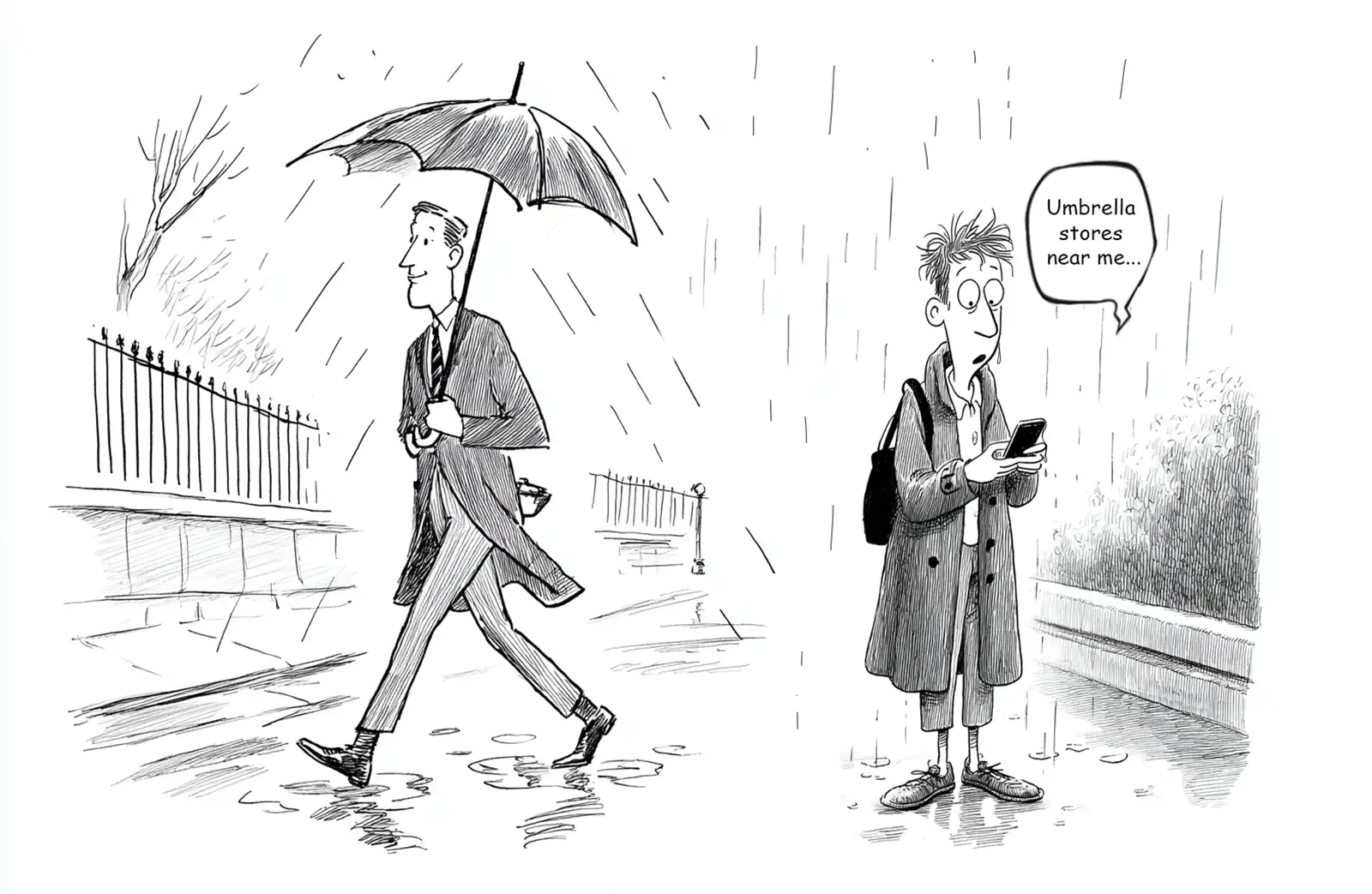
Hope For The Best, Plan For The Worst
Shifting from a reactive to a proactive approach to security has compounding effects. It reduces the cost of incidents, accelerates enterprise sales, builds customer trust, and makes your systems more reliable and your team more capable.
STRIDE won't entirely eliminate risk (no framework does) but it gives you and your team a structured way to see where your product is fragile, make deliberate tradeoffs, and have informed conversations with customers, partners, and investors.
For smart business leaders, good security is a competitive advantage built in from the beginning, long before it has a chance to become a technical problem.
TL;DR
- STRIDE provides a simple framework to identify six common types of security risks before they become problems.
- Asking better, more specific questions early leads to stronger design decisions and lower long-term costs.
- A structured approach to security strengthens enterprise sales by making you audit-ready and credible.
- Embedding security thinking across the team removes bottlenecks and improves overall engineering quality.




The TSG Team
Articles written by "The TSG Team" are a collaborative effort by the TSG Marketing team. They bring together our company's beliefs and philosophies as a whole, including the opinions and collective experience of many of our on-staff experts.